
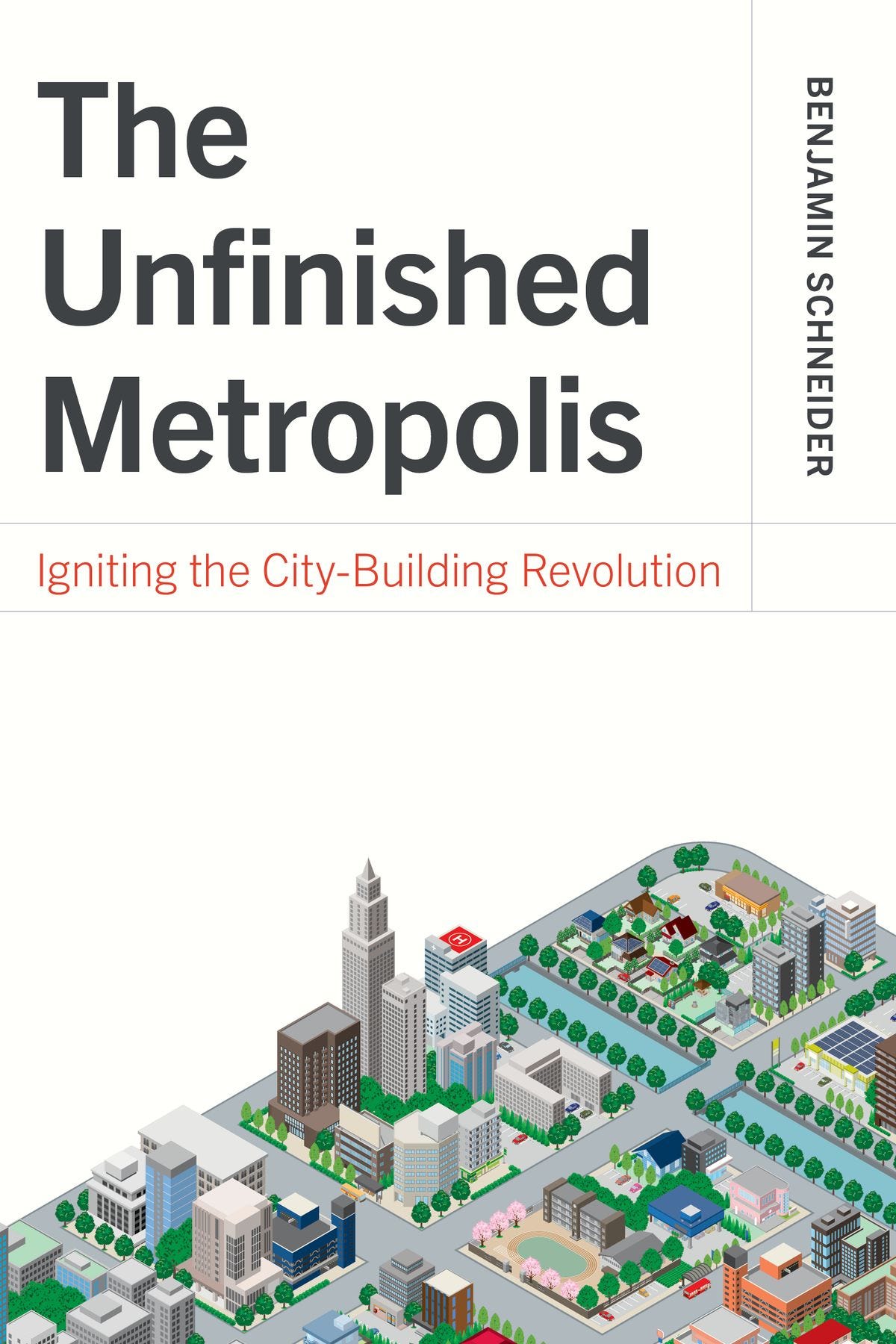
American cities are retarded. Perhaps that sentiment could stand to be further explained. I use American in the most casual sense, in reference not to the continents but to the United States of America in particular; I use retarded in the most literal sense, in reference to a progress being hindered or halted. Keeping those definitions in mind, we have what amounts to the premise of Benjamin Schneider’s new book The Unfinished Metropolis, albeit expressed in a way the author gives the impression of being unwilling to do even in his own head. The proportion of Americans with passports has lately crept up to 50 percent, but even among the half who’ve never gone abroad, many will by now have at least an inkling that their major cities haven’t kept developmental pace with those of Europe and Asia. Comparative deficiencies in public transit and “walkability” have often been lamented, but the lack of less measurable qualities like appealing public spaces and an ambience of life on the street could similarly be ignored only by a die-hard urbanophobe.
Schneider, a die-hard urbanophile who did two years of research visiting a couple dozen major cities both inside and outside the U.S., takes it as his journalistic mission to explain why that happened and what can be done about it. Each resulting chapter of this book takes on one aspect of the American city’s grand retardation. Zoning laws influenced by “the cult of the single-family home” grew increasingly rigid in the twentieth century, making it impossible to build enough housing either to endure a modicum of affordability, let alone to offer the poorest an alternative to life on the street. The auto industry’s lobbying turned once-lively streets into the exclusive property of motorists encouraged to drive them at higher and higher speeds, which not only distorted them out of human scale but also made them inconvenient, even dangerous, to so much as cross. The money that paid for robust prewar streetcar and passenger rail networks dried up, never to be replenished, and the vast postwar freeway system (along with the oversupply of parking dictated by the assumption of universal automobile use) did grievous, possibly irreparable harm to the cities through which it ran. As suburbs prospered while downtowns bled out, the ostensible cure of “urban renewal,” with its misconceived high-rise housing projects and its isolated civic and cultural centers, usually proved as bad as the disease.
These stories have been told before, some of them many times, including in books previously covered here: Steven Conn’s Americans Against the City, Henry Grabar’s Paved Paradise, M. Nolan Gray’s Arbitrary Lines. That last is, like The Unfinished Metropolis, a publication of the environmental and urban policy-focused Island Press, whose titles also include Jarrett Walker’s Human Transit. Walker contributed a blurb to Schneider’s book, calling it “an encouraging survey of the great task before us: to make make American cities great again.” The economist, blogger, and podcaster Tyler Cowen, whose Emergent Ventures program provided grants that, in part, supported the work behind both this book and Gray’s, uses very nearly the same expression in his own endorsement. He also mentioned the book in a post on his blog Marginal Revolution, which I’ve read for decades, though without any indication of the extent to which he agrees with the proposition that American cities need to be made great in the first place. His more recent podcast interview with Dan Wang, author of Breakneck: China’s Quest to Engineer the Future — a book that makes own indictments of the U.S.’ comparatively sluggish urban development — makes me think he’d have his objections.
“Doesn’t America just have better infrastructure than China?” Cowen asks Wang by way of an opener. “Let’s say I live in Columbus, Ohio. What exactly am I lacking in terms of infrastructure? I have this great semi-suburban life. It’s quite comfortable. What’s the problem?” Something about the question makes me hear it as just one provocation in a long-running back-and-forth between the two. In any case, Wang grants that “America has excellent infrastructure if you own a car,” but argues that the “quality of life will be substantially higher” for everyone, suburbanites and urbanites alike, if the the U.S. massively upgrades its rail transit systems running within and between cities. “I agree that we should build more rail,” Cowen responds, “but mostly we’re not going to. We’ll improve airports, add more flights.” And absent the possibility of a revolution in American rail, why not “just get everyone a car, or almost everyone”? After all, “what we have are the very best suburbs,” and “suburbs are the future.” This exchange contains several assumptions worth considering, one being that a suburb of sufficiently high quality can substitute for a city. Another, even more relevant here, is that American civilization essentially, or ideally, takes a suburban form.
There are no doubt many Americans who would agree with that conception, whether or nor they’d put it in those terms themselves. We live in detached single-family houses, arranged into neighborhoods consisting only of such houses; when we need to go somewhere, we get in our cars and drive there: this is what Schneider quotes Donald Trump as branding, in a tweet during his 2020 presidential campaign, “the Suburban Lifestyle Dream.” (The Trump administration comes up again and again in as the chief obstacle to the U.S.’ twenty-first-century urban renaissance, and at one point Schneider suggests that “city-building could offer a new means of ‘resistance’ for Democrats that is constructive rather than symbolic.) Major cities like New York or Los Angeles may have a high cultural profile across the entire world, but they remain exceptional to rather than exemplary of the country’s decentralized nature, which could never accept containment within the sheer urban concentration of a Paris, to say nothing of an all-encompassing capital like Seoul, where I happen to live. The Hamiltonian metropolis has become irrelevant, and given the state of many rural areas, so has the society of Jeffersonian yeoman farmers: the much-invoked real America is, in fact, suburban.
Whether all that is actually true I couldn’t say, at least not without conflating it with the question of whether I personally want it to be true. Schneider surely doesn’t want it to be true, given the frequency of his encouraging words about the potential for American re-urbanization. In the The Unfinished Metropolis‘ final chapter, he reiterates them all, underscoring the non-impossibility of everything from the end of single-family zoning to the permission of single-stairwell apartment buildings to the dedication of exclusive, protected bike and bus lanes. These are just a few of the goals pursued by the movement known as YIMBY, or Yes In My Backyard, named in opposition to the NIMBYs whose influence in city politics bears outsized responsibility for many if not most of the urban deficiencies Schneider diagnoses. Of course, it must be the rare self-described YIMBY who actually has a backyard in the first place, given their tendency toward youth and economic status well short of affluence. Schneider is a freelance journalist (and fellow Substacker, I might add), and though I haven’t looked up his age, I would guess he’s in his late twenties, or maybe his early thirties.
Though sturdy and clear throughout the book, Schneider’s prose occasionally betrays the tendency toward skittishly conformist euphemism (as well as the assumption of sometimes implausible causal power on the part of social prejudices) characteristic of that generation. He uses term “unhoused” four times, for example, and once even goes all the way to “people experiencing homelessness.” This is one sign of a writer preaching to the choir, or in this case to multiple choirs, one of which — that of the urbanists — can claim me as a member. I may have lived outside the U.S. too long to get the last few political-correctness updates, and quite possibly have stayed abroad in part out of a disinclination to encounter speech thus mangled in my immediate surroundings. But a larger reason to live in Seoul, to my mind, is that my homeland has no cities to match it, and — let’s face it — probably never could. There is, of course, New York, which retains its appeal in the face of wearying bursts of disorder and grinding costliness. But as Schneider acknowledges, considerable aspects of that appeal owe to the fact that they were set in stone (or at least concrete) before the American anti-urban regime set in. The structures lining Central Park “form a forbidden city within the city: a collection of well-loved, well-functioning buildings that public policy treats as a mistake.” And as for the subway system, by far the busiest and most extensive in the country, almost all of it was up and running before World War II. (The most recent addition, the two-mile-long initial phase Second Avenue Subway, opened in 2017 at a cost of about $7 billion.)
Los Angeles, where I used to live and which still fascinates me more than most places in the world, comes off in The Unfinished Metropolis as the poster city for twenty-first-century American re-urbanization that it more or less is. If a reader unfamiliar with that phenomenon were somehow to pick up the book, they’d be startled to learn that the “L.A.” they imagine has public transit of any kind, let alone a subway system currently undergoing a long and ambitious-by-U.S.-standards expansion. But the fact remains that none of its stations have bathrooms, to my knowledge, let alone ones that don’t subject their users to waves of fear and disgust. Schneider doesn’t touch the public restroom question at all, maybe because it would be too demoralizing; better, or at least more realistic, to focus on how to make possible the amount of housing and infrastructure already considered standard in other, supposedly less developed parts of the world. The question of why Los Angeles in particular and American cities in general lacked certain traditionally urban qualities soon consumed me when I lived there, and drove the phase of city-book reading I was in at the time. Had it been published then, Schneider’s book, which broadly addresses almost all the relevant factors in a single compact text, would have made for a highly clarifying read.
It wasn’t long thereafter that I began writing professionally about cities myself, publishing first a series of essays on different parts of Los Angeles for a local public TV station that drew the attention of an editor at the Guardian. He was leading the team just about to launch a Rockefeller Foundation-funded site dedicated to cities, one manifestation of what turned out to be a minor flowering of urbanism-focused online media that would mostly wither by the early years of this decade. Guardian Cities shut down in 2020; Atlantic Cities, which launched around the same time with the participation of urban-vitality guru Richard Florida, ended up re-branded to CityLab (a name that at least doesn’t bring to mind a Monopoly board) and sold to Bloomberg, where it was dramatically de-staffed. Schneider nevertheless managed to land a fellowship there, an experience he found formative enough to dub it “CityLab University” in The Unfinished Metropolis‘ acknowledgements, and indeed, the book bears the wonk-Democrat journalistic mark of that venue. (None of its quotations is less surprising that the one from Ezra Klein and Derek Thompson’s Abundance in the chapter on reindustrialization.) Still, however professionally suitable, the kind of depersonalized perspective it uses always puts me at something of a loss. Schneider answers many questions, but not the one that eventually rose to the top of my mind: what, exactly, is the city to him?
The book itself offers scant biographical information: the “About the Author” paragraph mentions Schneider’s having been born and raised in San Francisco and now living in Brooklyn, with stints in Los Angeles, Manhattan, and Washington, DC in between. This extended immersion in both the pleasures and shortcomings of some of these most urban of all U.S. cities could constitute the material for a book by itself, and one with the potential to persuade those many of our countrymen without direct experience of city life at that. (As he himself observes, “Americans have trouble believing that buildings and infrastructure can improve their lives because they’ve never seen it happen.”) Also worth hearing would be the kind of full-throated argument for the city — a superfluity in many countries, but certainly not the U.S. — Schneider could make to a worldly contrarian like Tyler Cowen, which makes me hope he eventually gets his day in Conversations with Tyler‘s hot seat. The Unfinished Metropolis was the proper first book for him to write, and it’s all to the good that it wasn’t published under the tentative title Living for the City, which he can thus use for a later, more personal work befitting it. Presumably, he has plenty of career left in which to write it.
Based in Seoul, Colin Marshall writes and broadcasts on cities, language, and culture. His books include 한국 요약 금지 (No Summarizing Korea) and Korean Newtro: Where Youth Meets Tradition. Follow him on the social network formerly known as Twitter at @colinmarshall.
thanks, genuinely not a book I would ever have heard of without this amazing Substack. There are some interesting interviews with Benjamin online, in one of which it is mentioned that he is thirty.
I have ordered the book and I am working my way through it, a thoughtful analysis of how what might seem like quite arcane policy choices really impact every day lives, and not always for the better