
First-time visitors to Seoul tend to go home favorably impressed by the city on the whole, if not by its appearance in particular. Some may feel relieved to find that, contrary to the impression given by so many photographs in Western media, it isn’t just mile after unrelieved mile of indistinguishable tower blocks. Yet apart from certain central tourist sites, like Gyeongbokgung, the main royal palace, or Namsan, the mountain with its speared-revolving-restaurant tower, few of its vistas remain in memory for long. Seoul’s built environment can strike outsiders as at once too monotonous and too eclectic: architectural form and decoration do vary, but mostly in odd or illegible ways.
It must also strike some insiders similarly, given the proliferation in recent years of Korean books about the proper arrangement of urban space, certain of whose authors have risen to at least minor celebrity status. The architect Yoo Hyunjoon, for instance, has extended his brand with a popular Youtube channel called Sherlock Hyunjoon, on which he often investigates the mystery of why the development of Seoul has produced results so much less satisfactory than in other world cities.
Though I enjoy Yoo’s work — despite, come to think of it, still being unfamiliar with his actual architecture — I can’t say that I share his opinion of Seoul’s deficiencies, even after having spent more than a decade here. To my mind, it has no deficiencies, or at least none that bother me enough to inspire fantasies about living elsewhere. This view isn’t entirely uncommon among longtime Western expatriates, even those who reliably launch into rants against Korean society a few drinks into the night. Many of us, after all, moved here from countries whose major cities, despite their considerable wealth, suffer from impediments to business, rates of violent crime, inadequacy of public transit, and daily inconveniences that simply wouldn’t be accepted in twenty-first-century Seoul. To us, the existence of usable restrooms in every single subway station feels like nothing short of a miracle, as I often tell bemused Koreans. (”But where do you go in New York if it’s an emergency?”) Many of them seem not to perceive these qualities — or rather, to perceive more clearly the fact that their capital has nothing to match Central Park, Champs-Élysées, or even the alleyways of Tokyo.
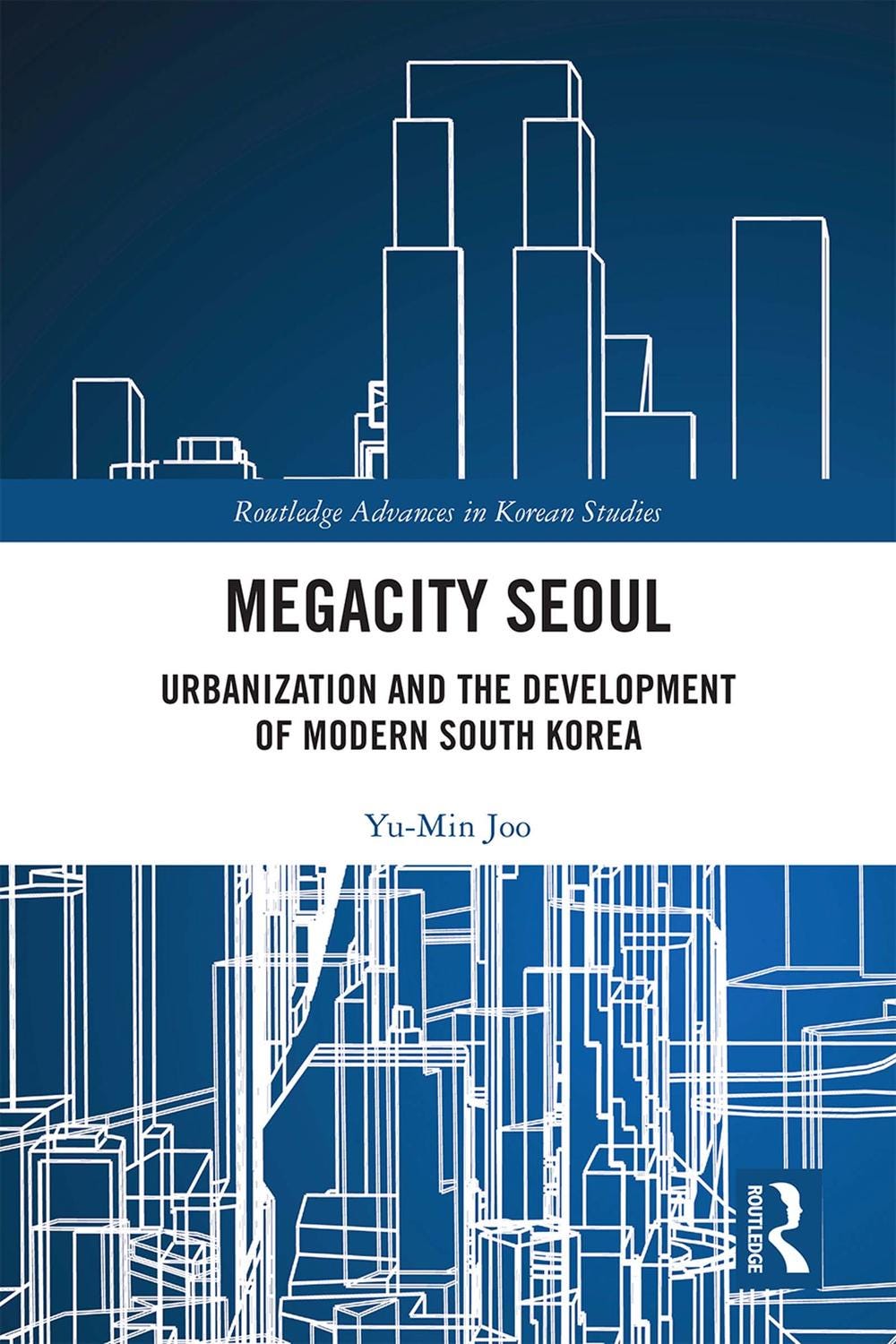
To call Seoul the capital of South Korea may be technically accurate, but rather understates the importance of the place. So does the population figure of 9.5 million strictly within city limits, as opposed to the 26 million — half the population of the entire country — in the Seoul metropolitan area. The latter agglomeration more than qualifies as a “megacity,” which label inspires the title of a 2018 study by Yu-Min Joo, a professor at the government-run KDI School of Public Policy and Management in Korea. Megacity Seoul: Urbanization and the Development of Modern South Korea is the first book in English of which I took note that explains the city’s evolution from the aftermath of the Korean War into the twenty-first century. Joo frames the development of the capital, “the command and control center of the Korean economy,” as inseparable from the development of the country itself. Each stage reflects the challenges faced by South Korea: postwar reconstruction, industrialization, severe and persistent housing shortages, building a middle-class, attaining the informal but coveted title of “global city.” Despite Seoul’s high tolerance of — some might say excessively hearty appetite for — a perpetual teardown-and-rebuild cycle, all those layers of modern history remain visible, to one degree or another, at least for those who know where to look.
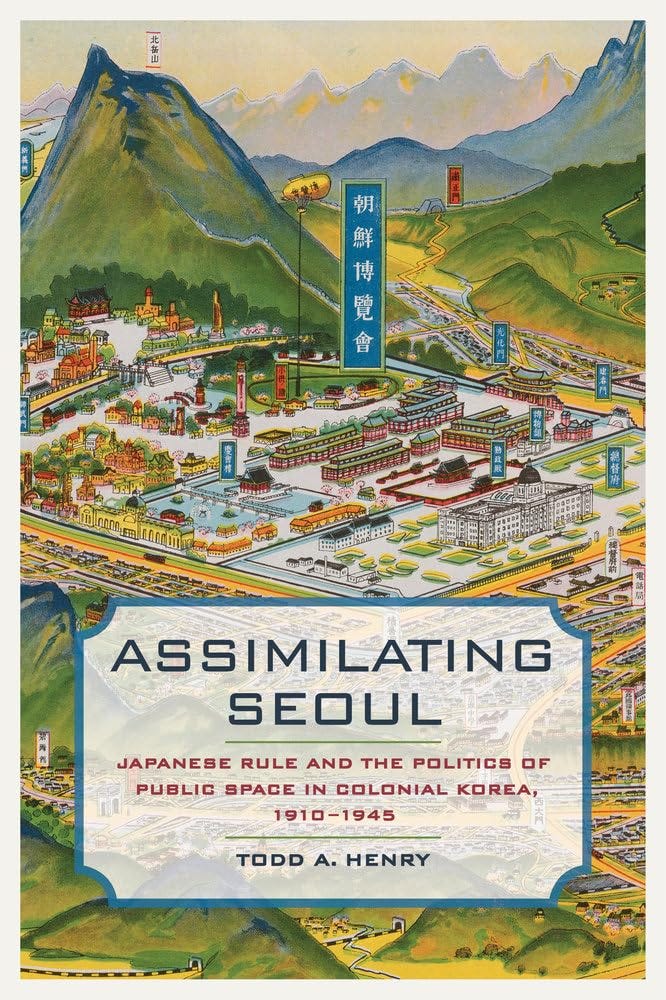
As popular saying in Korea these days has it, “you see as much as you know”: true in the foreign tourist capitals Koreans avidly study before touring, but no less so in Seoul itself. Why it’s taken the particular form it has is a question countless books have addressed in Korean. (The most notable exception may be the French geographer Valérie Gelézeau, whose work on Korean housing in books like Séoul, ville géante, cités radieuses gets cited even by domestic scholars.) The great English-language work of nonfiction on Seoul for a general readership may have yet to appear (so I remind myself), but the past dozen years have brought forth several academic or otherwise specialist books with the potential to deepen any interested reader’s understanding of the city. A few years before Megacity Seoul came Assimilating Seoul: Japanese Rule and the Politics of Public Space in Colonial Korea, 1910–1945 by UC San Diego historian Todd Henry. This year came another academic book, Indiana University Bloomington professor of Korean History Russell Burge’s The Promised Republic: Developmental Society and the Making of Modern Seoul, 1961–1979, about the capital’s swift if contested development in that period with a focus on informal settlements.
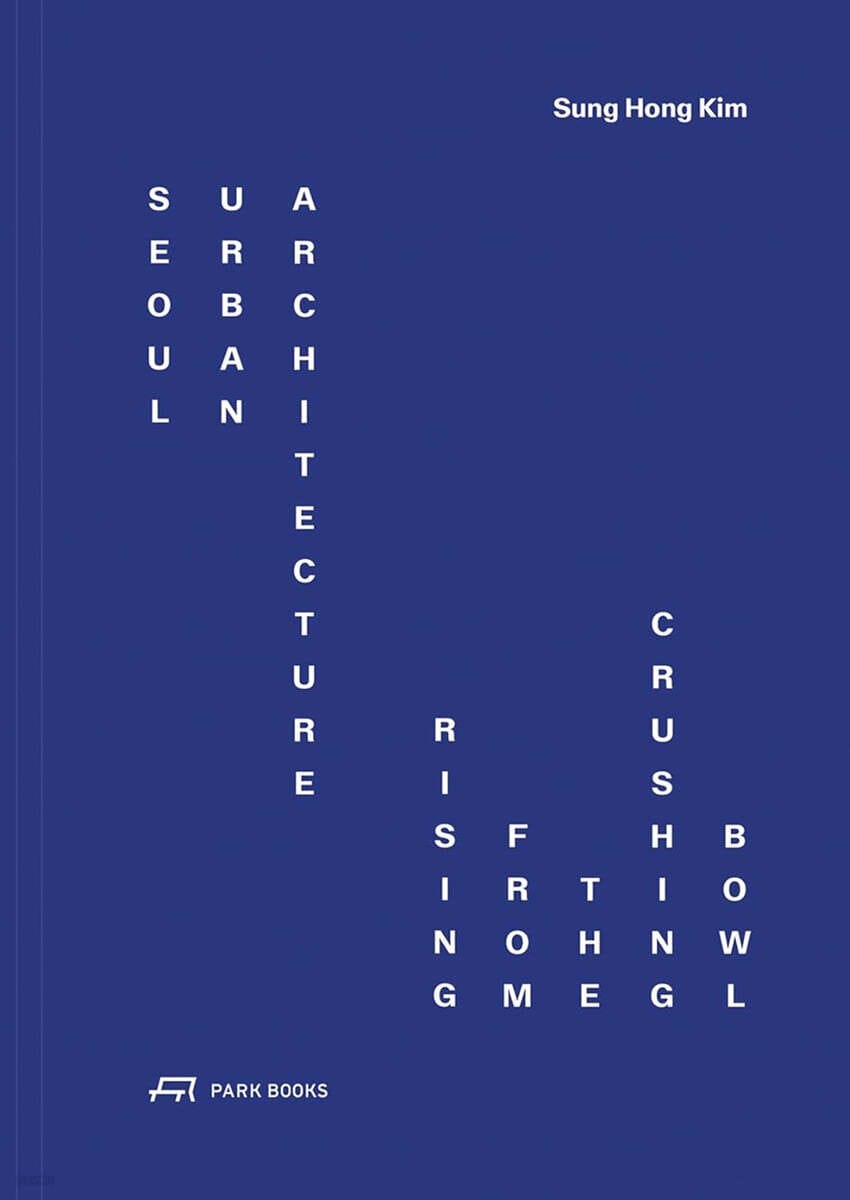
So did the less formally categorizable, visually much richer Seoul Urban Architecture: Rising from the Crushing Bowl, by University of Seoul professor emeritus of architecture and urbanism Sung Hong Kim. The subtitle’s metaphorical reference seems to be to a mortar, the kind that goes with a pestle. “If New York City can be likened to a ‘melting pot,’ where a new culture is born out of the process of homogenizing different cultures and races within a hyper-dense environment,” he writes in the introduction, “Seoul can in many ways be personified as a ‘crushing bowl’ where, rather than being melded, heterogeneous elements have been pulverized together by a continuous onslaught of strong and brute forces. Over the past one hundred years alone, Korea has suffered from colonization, war, a military coup, and dictatorship, and Seoul been at the epicenter of these struggles throughout.” This passages delivers a fair idea of the story Seoul Urban Architecture tells, as well as the prose it tells that story in. As a Westerner who often writes in Korean, I’m not about to throw any stones, but odd notes like that use of personified and the uncomfortable proximity of melt and meld occur throughout the text, suggesting that it could have used another, more aggressive round of edits.
I’m in any case inclined to overlook the book’s rough edges, at least in this first edition, since it seems in many ways to have been written just for me. That’s due not just to my being an urbanism-minded Westerner living in Seoul who’s felt compelled to understand the city even before moving here, but also to the appreciation Kim’s evidently shares with me for Reyner Banham. He references Banham’s definition of modernism in Theory and Design in the First Machine Age, from 1960, and his borrowing of the term megastructure from Japan’s Metabolist movement, but Los Angeles: The Architecture of Four Ecologies, the longest-standing entry in my personal city-book canon, goes unmentioned. Though it wouldn’t right to call Seoul Urban Architecture this city’s equivalent of The Architecture of Four Ecologies — it’s more technical, more production-intensive, much less breezy, and features no dingbats — it is, for the moment, the closest thing on offer.
One major difference between those two books manifests in the authors’ cultural perspective. Banham was an Englishman, Norwich born and raised, and thus well-placed indeed to appreciate what must have felt like the anything-goes aesthetic and technological libertinism of Los Angeles in the nineteen-sixties and seventies on his sojourns there. (The late David Hockney, a beloved artist in Korea, must have felt similarly.) That appreciation could, perhaps, seem excessive to locals: “The trouble with Reyner Banham,” wrote Peter Plagens in his notorious Artforum broadside, “is that the fashionable sonofabitch doesn’t have to live here.” Though not technically a son of Seoul, Kim made the move from countryside to capital for university, as did many Koreans of his generation. “Other than the time spent abroad to further my studies, I’ve lived as a resident of Seoul for more than forty years. And yet, Seoul has never felt like a home to me. I’ve moved eleven times across the city, and like many other people who migrated from rural towns to Seoul, I will probably always feel like an urban nomad.” Such a feeling of persistent alienation, often expressed in Korean literature, is hardly unknown among Seoulites.
Kim’s writing isn’t entirely free of the peculiar oscillation between nationalistic exaltation, bitter resentment, and unpredictable defensiveness that Koreans often demonstrate when talking about their country to foreigners. Not that he gives the impression of an un-self-aware “frog in a well,” the local insult for someone with too little knowledge of the wider world to see outside the domestic context. In a late chapter, he relates the experience of being asked, at an exhibition of art depicting “typical multifamily residential buildings found in every middle-class neighborhood in Seoul,” whether those structures are “part of Korean urban vernacular.” “For some reason, his use of the word ‘vernacular’ was unsettling to me,” he writes. “His question was clearly not meant to be impolite or intrusive, but some deep cultural sensitivity within me was triggered.” Maybe it was an implication that ordinary Korean buildings where ordinary Koreans live belong outside the category of architecture proper; maybe it was the outsider’s application of a category unrecognized in Korean culture, and indeed with no equivalent in the language. Whatever the thinking behind the question, Kim concludes, “there is no need for such sensitivity” in considering it.
That said, I’ve come to feel that anyone trying to understand Seoul’s built environment, foreigner or Korean, ignores the kind of housing examined in that exhibition at their peril. I myself only really started thinking about it a few years ago when, just before getting married, I moved to a neighborhood way out in the west of the city that I’d always regarded, at least when my eyes happened to pass over it on the subway map, as the back of beyond. Most of my walks there take me past countless modest three- and four-story brick buildings called as billa (a Koreanization of the word villa), and the more I see them, the more I notice the “haphazardly added elements” Kim describes the artists as capturing. “In an effort to expand rentable space, basements are slightly raised above the ground; rooftops are converted into rentable rooms; open balconies are extended to the edges of eaves and wrapped with cheap metal sashes and glass.” (Examples appear in this blog post and this video interview with one of the artists, Kang Seong-eun.) “While Seoul tries to measure up to the prestige of other global cities, the awkward and disjoint appendages in these buildings mock such an endeavor, as they chronicle a disorganized and desperate search for additional living space.” In a more than trivial sense, perhaps Korea has its own dingbats after all.
To a great extent, the history of modern Seoul is the history of modern Korea, and the history of modern Seoul is the history of its housing. The humble billa represents one chapter, as does its ever-less-humble successor the apateu danji, the popular form of lookalike high-rise apartment complex that tends to get Westerners invoking George Orwell. Writing about an earlier, much poorer period of South Korean history, Burge focuses on a form of housing that would barely be recognizable as such to young Koreans today: the panjajip, often translated as “shack” or “shanty,” which proliferated in the years after World War II, and even more so after the devastation of the Korean War. (I first encountered the word as the name of a favorite makgeolli-and-jeon joint in the college neighborhood where I used to live, whose relationship with informal construction did feel more than historically evocative.) Banged together out of plywood and scrap metal, they clustered together in makeshift villages called panjachon in places like the banks of the Cheonggyecheon, the urban stream later paved over, and later still reconstructed as one of the signal attractions of a Seoul eager to be seen as turning away from the pure developmentalism of postwar decades and prioritizing the citizenry’s quality of life.
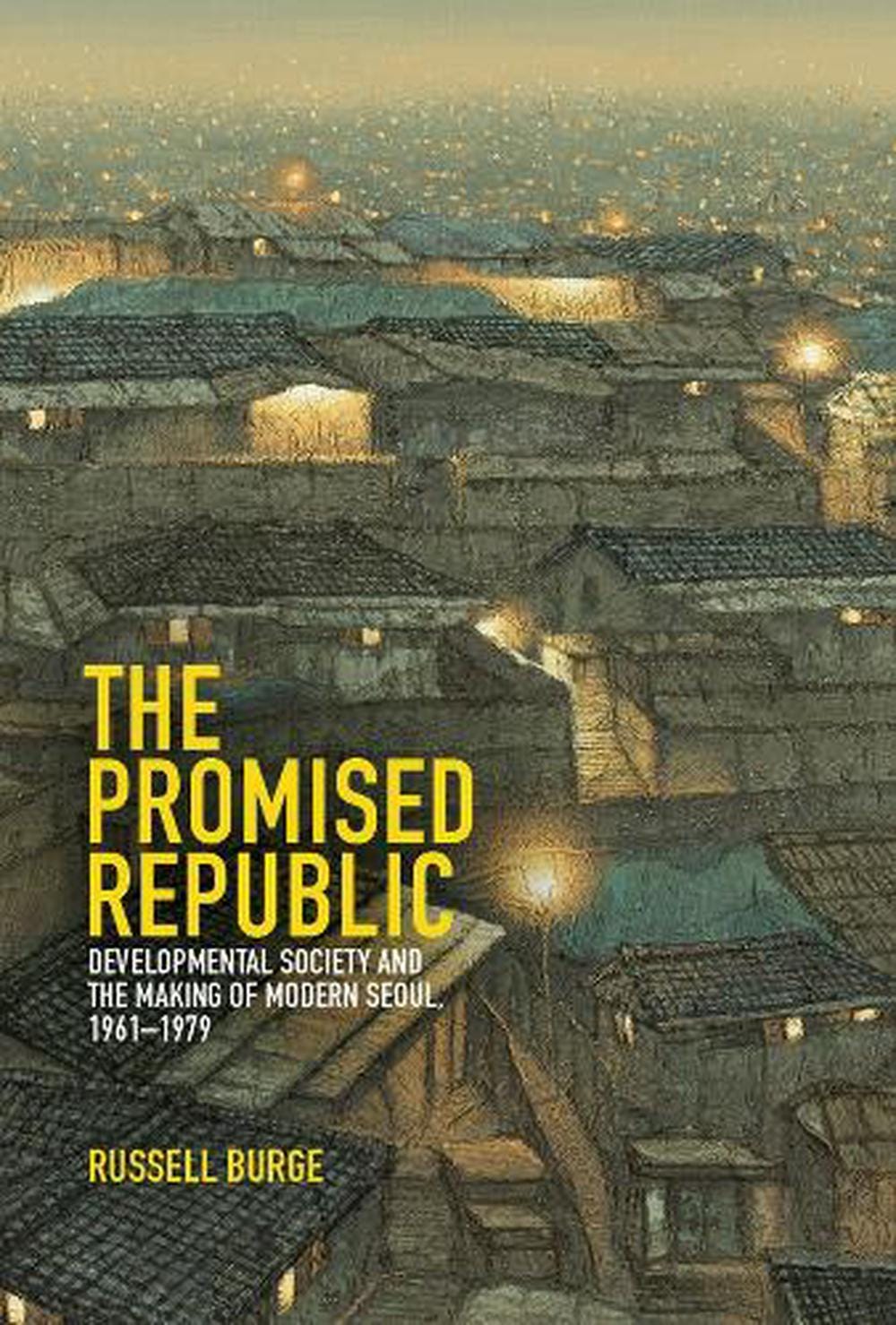
It was the developmentalist government, ascendant in the period Burge covers, that made a priority of eliminating the panjachon, which was easier said than done. The only viable option for impoverished domestic migrants flooding into the capital of a severely resource-strapped new state, these slums were born of dire necessity and soon became entrenched. In the face of coercion and even violence, some panjachon proved more resistant than others: their residents protested for their right to remain where they were, or to receive new living spaces in the modernized city with the rising standard of living the military dictatorship meant to legitimize itself by providing. Even if they managed to extract promises from officials, the ultimate result could be a far cry from what they’d envisioned for themselves. The especially unfortunate ones might find themselves relocated to harsh, remote places without the facilities needed for survival, but even those in possession of the theoretical right to move into the apartment complex slated to replace their ramshackle neighborhood often had no practical choice but to sell it immediately. Constructed in great haste, those new developments could be more perilous than the panjachon: in 1970, one building in a series of “Citizen Apartments” slid off its foundation and down an embankment, killing thirty-three people and forcing the resignation of mayor Kim Hyon-ok, known as “Bulldozer.”
Of the many structures more successfully erected during the four-year reign of the Bulldozer, none captures my imagination quite as much as Sewoon Sangga. Despite frequent calls for its demolition, most of that Cheonggyecheon-spanning megastructural linear complex of electronics shops and luxury apartments still stands 58 years later, though the shops do a fraction of business they used to, and the few apartments not converted into offices have deteriorated to the verge of uninhabitability. In the twenty-tens, it was mildly revamped and even partially gentrified with bookstores, galleries, and cafés under the mayoral administration of the restoration-and-reuse-minded Park Won-soon, with his mission to build what Joo describes as “a citizen-centered Seoul.” Megacity Seoul came out about a year and a half before Park’s suicide, which left a vacancy filled by Oh Se-hoon, who’d been mayor before. Sewoon Sangga and its light-industrial surroundings were among Oh’s bêtes noires even in his first term; he “vowed to replace them with a park in 2023,” Kim writes. “And this begs the question: Why has an old place like the Sewoon Plaza endured, and why has so much resistance and public backlash gone into stopping development here?” (Not to turn editor myself, but I do wonder how that “begs the question” survived.)
Beloved though it may be by urbanist Westerners such as myself, Sewoon Sangga inspires more complex feelings in Koreans, especially those involved in architecture and urban development (many of whom happen to belong to the generation that grew up knowing it only as a one-stop shop for pirated or otherwise prohibited media). Yoo Hyunjoon has remarked on Youtube that it would obviously be better off demolished. Kim makes a more contradictory assessment: though Sewoon Sangga and its adjacent areas “have long been a major urban blight that, when solved, have the potential to ignite the transformation of the city,” it also has “a bustle of activity and a resonance with social and cultural satisfaction. While modernization projects may promise to sweep away old and decrepit structures in favor of new ones, they rarely succeed in recreating the socio-cultural energy that had existed before.” What’s worse, “depending on changes in laws, policies, and economic conditions” — to say nothing of the trustworthiness of the politicians involved — “these areas could quickly transition to an unexpected and undesirable form of redevelopment.” None of the proposed replacements for Sewoon Sangga, which have everything to do with the generic “world-class city” and nothing to do with Seoul in particular, have interested me in the least. It’s perhaps relevant that, in his first term, Oh presided over the acquisition of Zaha Hadid’s Dongdaemun Design Plasa.
I’d be remiss in neglecting to mention that among the Korean architects who disapproved of Sewoon Sangga is Kim Swoo-geun, who designed it. The good thing about being the foremost member of that profession in a country like South Korea in the sixties is that, if the government likes you, you get the large-scale projects meant to signal modernity and all the resources that can be marshaled for those projects. The bad thing is that those resources may may not amount to quite what’s needed, and in any case, the caprice of the political actors involved means that everything can be compromised on short notice. As it happens, Sewoon Sangga as built fell well short of the true city-within-a-city of Kim’s original plans, which even included a self-contained transport system. (One thinks of Victor Gruen, whose designs for independent urban ecosystems were bowdlerized by American developers in the fifties into enclosed shopping malls, refusing to “pay alimony for those bastard developments.”) Regardless, I take almost every visitor from abroad there for a stroll through its warren of arcade cabinets, CCTV gear, karaoke machines, and stereo amplifiers, followed by a hazelnut iced coffee at my favorite dabang, or old-school café. My most common recommendation for tourists is the Arario Museum, which operates in the office building Kim designed for his firm SPACE Group — not that many take me up on it.
Sewoon Sangga and the Arario Museum offer two of the most spatially interesting experiences in Seoul, to my mind. But while the former is concrete (and for that reason, often inaccurately described as brutalist), the latter is brick, a material more representative of both Kim’s aesthetic and the Korean built environment itself. The family resemblance between the SPACE Building — or Kyungdong Church, or the ARKO Art Center — and any given anonymous, erratically modified billa may be vague, but it’s there. Kim’s use of bricks has been framed as the result of his questing for a genuinely Korean form of modern architecture, one inspired in part by the sense of space he remembered from his formative years in Seoul’s Bukchon neighborhood, with its narrow walled lanes winding between hanok, traditional courtyard houses in a scaled-down urban form. This desire seems to have been genuine, though a felt need to distance himself from Korea’s former colonial master could have been its own motivating factor. Though born in what’s now North Korea, Kim studied in Japan, which wasn’t an uncommon choice among Korean architects of his generation: so did his older colleague and rival Kim Jung-up, also included in Seoul Urban Architecture as one of the first generation of Korean modernists. But Kim Swoo-geun also had a Japanese wife, and drew a storm of controversy early in his career after Kim Jung-up publicly noted that the younger man’s Buyeo National Museum resembled a Shinto shrine.
The building may seem innocuous, even kitschy, today, but all this happened in 1967, with the rule of what Sung Hong Kim calls Korea’s “atrocious colonizers” still well within living memory. The capital in the colonial period — then known as in Korean as Gyeongseong, or Keijō in Japanese — is the subject of Assimilating Seoul, which devotes one chapter to the Shinto shrines then installed atop Namsan and elsewhere. In Henry’s telling, the Japanese government had a hell of a time getting Koreans to go up there and pray in serious numbers or in a serious fashion, at least before the war really started to bite. His other chapters relate in similarly scholarly detail other such difficulties faced by the empire-glorifying exhibitions held at Gyeongbokgung (then dominated by the hulking Japanese Government-General Building) and public health and sanitation campaigns conducted in predominantly Korean neighborhoods. The latter involved installing public toilets, whose intended users, as Henry quotes from a report by a colonial organization called the Seoul Sanitation Association, “sometimes break down the bathroom door, steal it, and use it as firewood for underground heating in their homes,” among other destructive (or simply disgusting) acts.
Soon thereafter, Henry writes that “most Koreans submitted to police authority only when it impinged on their lives, engaging in an everyday politics of evasion and concealment that quietly undercut rule by sanitation.” (Though for the most part crisp and clear, his prose also betrays the tendencies of someone who’s been in the academic humanities too long, with its invocations of “subaltern bodies,” the “sanitizing prerogatives of the colonial state,” and the “praxis of postcolonial justice.”) In most histories of my acquaintance, the Japanese colonial period comes off as a hopeless project, a mission civilisatrice constantly undercut by, depending on your position, either brutish, belligerent Korean intransigence or sly, patriotic Korean resistance. Twenty years ago, Ian Buruma (author of Stay Alive, previously featured on Books on Cities) profiled Park Chan-wook, the director of such early Korean-wave films like Joint Security Area and Oldboy, for the New York Times Magazine. “There is one thing that can never be said in Korea,” Park tells hom. “You could never say that the Japanese occupation of Korea had been beneficial. That would create even more hostility than a movie praising North Korea. It would be like telling Jews that the Holocaust didn’t exist.”
Buruma writes that Japanese colonial rule “was often brutal, but it was no Holocaust. Much of the Korean elite collaborated, as they later would with postwar dictatorships, because the occupation brought benefits too: railroads, schools, industry, efficient administration.” But whatever infrastructural or institutional advances occurred in Korea between 1910 and 1945 — primarily made, as the common Korean view has it, for Japan’s own benefit — are nothing compared to the developmental “Miracle on the Han River” that occurred in the southern half of the peninsula over the second half of the twentieth century. In a sense, the military dictator Park Chung-hee, in power from his 1961 coup until his 1979 assassination, succeeded where the Japanese empire failed. One would still draw serious objections, I suspect, by comparing the rigors Koreans endured under Park’s administration to those they endured under Japanese occupation, but surely his unloved, also-unelected successor Chun Doo-hwan, during whose time in office an even richer South Korea geared up to host the 1988 Olympics, inspired certain comparable public resentments.
Korea has, in any case, been through a lot over the past century. That’s one way of simplifying the central thesis of Seoul National University sociologist Chang Kyung-Sup’s The Logic of Compressed Modernity, which, despite being written in both detectably non-native English and repetitive academese, makes for illuminating companion reading. Its titular concept is “a civilizational condition in which economic, political, social and/or cultural changes occur in an extremely condensed manner with regard to both time and space, and in which the dynamic coexistence of mutually disparate historical and social elements leads to the construction and reconstruction of a highly complex and fluid social system.” Rather than entering into modernity — or, if you prefer, Western modernity — on its own terms, Korean society had modernity thrust upon it, having been first “appropriated as a colony of industrial capitalism by an external force (Japan),” then “pressurized to accept the political and economic order of Western standards by another external force (the United States).” Decades of state-directed “national economic and civilizational catch-up” have left South Koreans trapped in “a multiplex theater society in which all possible claims of modernities are aggressively and loudly staged side by side and/or one after another, however, without a clear clue to civilizational or sociopolitical reconciliation among them.”
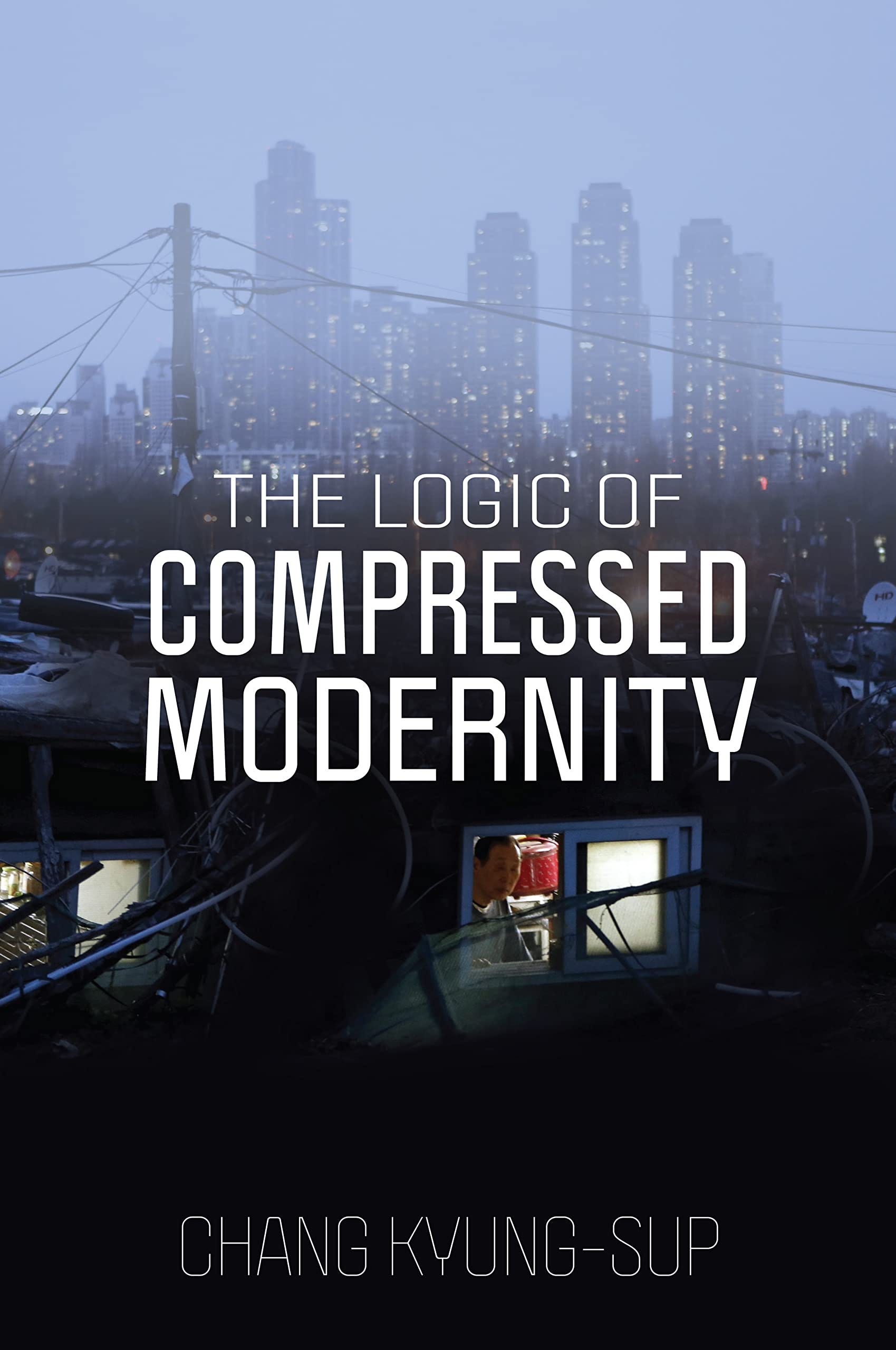
Of a rapidity unknown at the time and a nature still distinctive among the nations of Asia, South Korea’s development is today blamed for a range of ills from the anxious malaise of its population, even among members who’ve emigrated, to what would locally be called its jeongsin eomneun built environments, disorderly enough to impair thought. It goes without saying that no Korean city comes in for more such criticism than Seoul, regarded less as a capital than a manifestation of Korean civilization itself. It presents to the visitor a “dense collage of retail complexes of two to five stories, fully clad with lurid signboards of different shapes and sizes,” Sung Hong Kim writes. “From a Eurocentric architectural perspective, urban architecture covered with signboards neither conforms to classical architecture with its tripartite elevation, proportion, and order, nor adheres to modern architecture, which eliminates iconographic elements for a purely formal configuration.” Their style “challenges both the holistic concept of urban planning and the notion of pure autonomy in architectural structures.” That’s certainly one way of looking at it, though the longer I live in Seoul, the more I find that such structures’ lurid normality — not to mention their capacity to package vertically a whole street’s worth of commercial variety — can also be appreciated on a neither theoretical nor ironic level.
As these books prove, Seoul isn’t going without Western, or in any case West-oriented, scholarly interest. What I see less of in English is writing, or at least non-clichéd writing, on the experience of the city, on how it feels to be in it, move through it, inhabit it, and attempt to become a part of it over years or decades. In foreign languages, at least, Seoul has inspired much more work of the expert than the connoisseur, a distinction I hastened to draw in Korean in my first book, 한국 요약 금지 (or No Summarizing Korea). However much I learn or write about this city and country, or indeed any other, I prefer to do so in pursuit of not expertise but connoisseurship: that is, to gain an understanding of a place in order to deepen and enrich my own experience of it. Again, you see as much as you know. Thus far, that process has taught me, among other things, that much of the interest in Seoul or Korea lies in ordinary spaces: its countless cafés; its residential buildings, in the words of Philomena Cunk, “without any architecture in”; its inconspicuous restaurants specializing in single dishes, whose appeal I discussed not long ago in an interview with the peripatetic Chris Arnade.
Chris is a frequent visitor to Seoul, and in most every respect the opposite of the tourist who turns up and tries to set foot in as many tourist traps and Instagrammable historical sites as possible in the course of a week, never to return. Not for him the reconstructed royal facilities, the opportunistic sites of K-pop pilgrimage, the strategic landmarks by borrowed starchitects. (Naturally, Sewoon Sangga was the first place I took him.) Still, certain major attractions do have their merit, not least the Cheonggyecheon, which in the colonial period, Burge emphasizes, divided Korean neighborhood from Japanese even more starkly than the Han now divides the deep-rooted if occasionally ersatz Gangbuk to the north from the broad avenues and instant-city superblocks of Gangnam to the south. Over time, I’ve even developed an appreciation for the modern revival of a traditional culture that, as Chang Kyung-Sup puts it, “has sometimes claimed a significant historical and existential legitimacy regardless of its practical utility.” More and more often, I even catch myself pulling up TV documentaries about families who’ve quit their apateu danji for hanok. Whether my subconscious is gearing for a similar move is unclear. But I can tell you this much: the hanok would have to be in Seoul.
See also:
Jorge Almazán + Studiolab, Emergent Tokyo: Designing the Spontaneous City (2022)
Donald Richie, Tokyo: A View of the City (1999)
Tom Scocca, Beijing Welcomes You: Unveiling the Capital City of the Future (2011)
Robert Fouser, Exploring Cities with Robert Fouser (로버트 파우저의 도시 탐구기) (2019)
Based in Seoul, Colin Marshall writes and broadcasts on cities, language, and culture. His books include 한국 요약 금지 (No Summarizing Korea) and Korean Newtro: Where Youth Meets Tradition. Follow him on the social network formerly known as Twitter at @colinmarshall.