
Berlin, one often hears, is not Germany. Since only four or five percent of the country’s population lives there, that makes a kind of sense. But Berlin also happens to be Germany’s largest city by a fairly wide margin: the second-largest, Hamburg, has at least 1.5 million fewer people; less populated still are Munich, Cologne, Frankfurt, Stuttgart, Düsseldorf, and Lepizig. Yet even someone who’s never set foot in Germany is likely to know not just their names, but also something about their identities.
In China, by contrast, there are several cities more than double Berlin’s size of whom few Westerners have ever heard, to say nothing of their global cultural profile. If the likes of Shenyang or Dongguan have any plans to become the next big hot spot for international art or club culture, word has yet to get out. But Berlin has punched in a metropolitan class farther above its weight than any other city in Europe, and perhaps the world, for at least a century — including the troubled years of the Second World War, which left the German capital defeated, demoralized, and devastated.
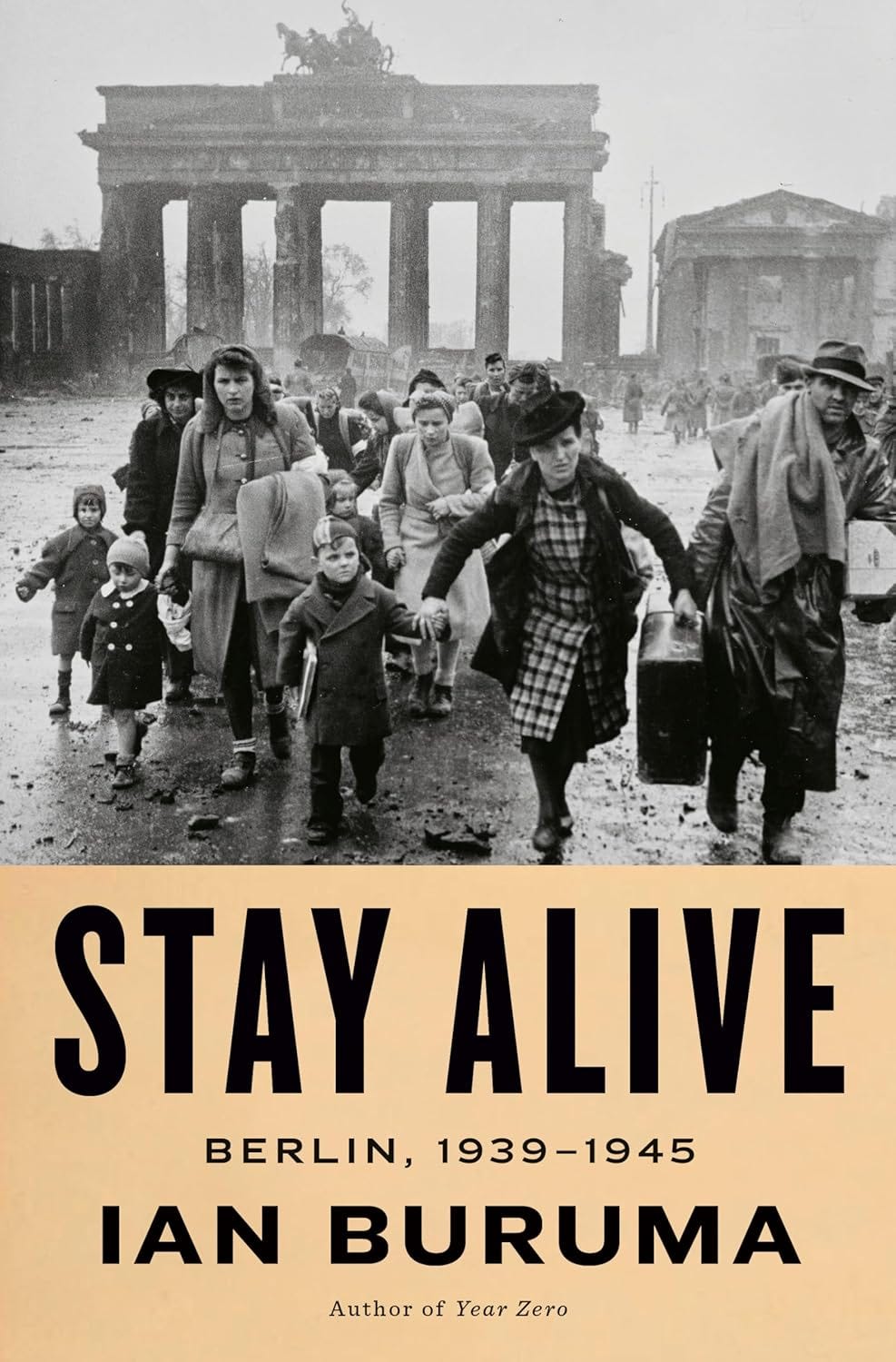
That’s the very period covered by Ian Buruma’s new Stay Alive: Berlin, 1939-1945. Buruma, now one of the few permanent residents of my to-read list, first came to my attention with his early books on Japan, where he lived in the seventies, as well as his writings on Asia in general. (Though not a Korean speaker, he’s also written more astutely on Korea than most outside observers.) Despite occasional manifestations of his interest in cities, such as a talk on anti-urbanism for the Architectural Association in 2002, I never let myself expect a proper city book from him, though his memoir A Tokyo Romance did come close.
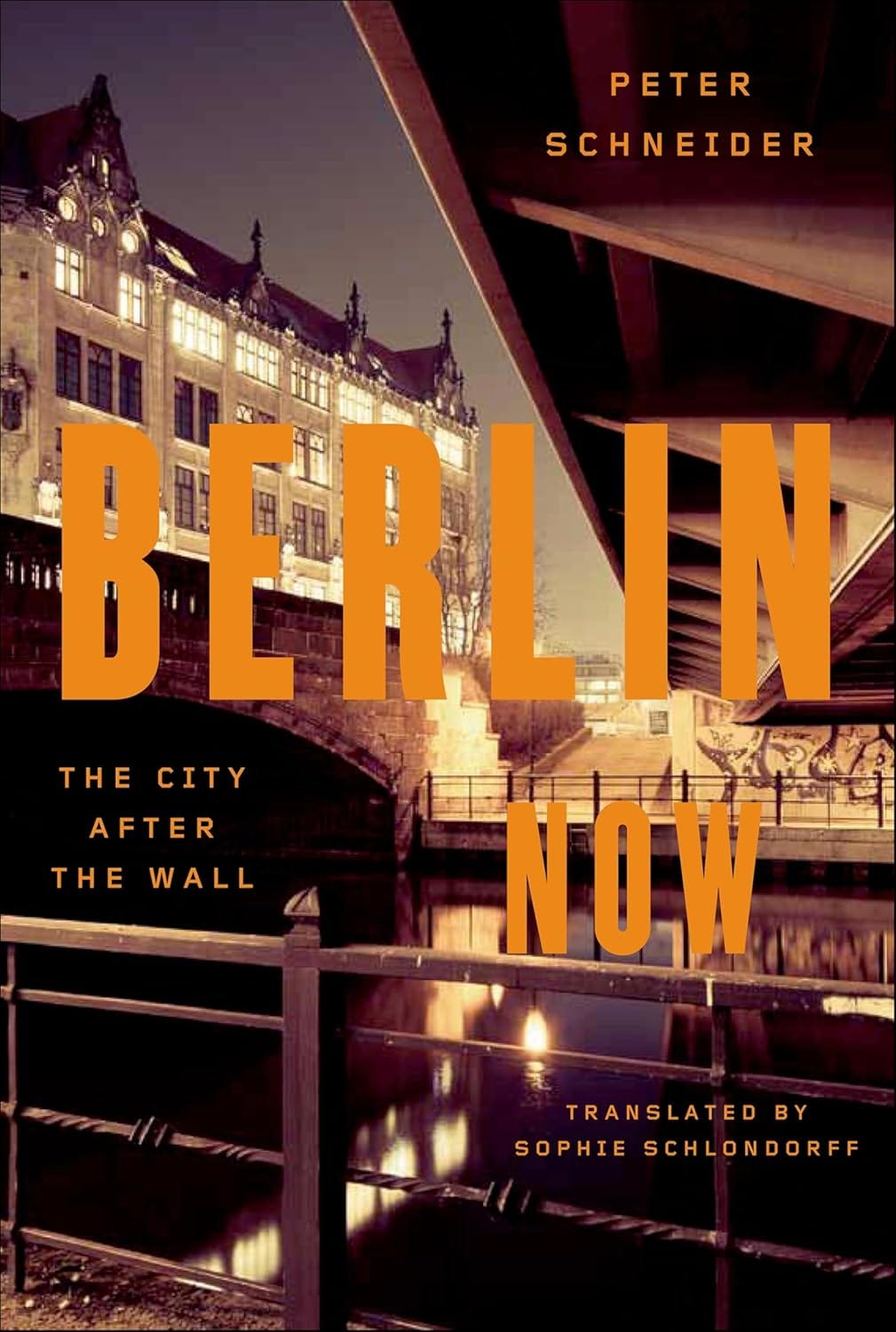
One reason is that a growing proportion of his work over the past fifteen years or so has been more concerned with the history and civilizational legacy of World War II. The most important of those books so far seems to have been Year Zero: A History of 1945, from 2013. Stay Alive, which ends when the war does, constitutes a kind of localized prequel: a city book for World War II buffs, or perhaps a World War II book for city buffs. In truth, before hearing that Stay Alive had come out, I’d originally planned to write only about a more straightforward city book, Berlin Now: The City After the Wall. The occasion was the death of its author, Peter Schneider, a nineteen-sixties leftist later known, even in the English-speaking world, as a critic of both Germany’s division and its re-unification.
When the book (and its English translation by Sophie Schlöndorff) was first published in 2014, the Berlin Wall had been down for a decade and a half, and Schneider himself was in his mid-seventies. His text does transmit some uncertainty about his fitness to observe what had by then become the prime destination for the younger generations of the New Europe (and farther-flung lands besides), but what he lacks in youth, he more than makes up for in experience. He first arrived in Berlin in 1962, stepping off the train from Freiburg eager to continue his studies in the metropolis — all the more so because being a student in the “front city” granted an exception from military service.
At that time, Berlin was, in a sense, surrounded by the enemy. Germany had been officially divided into East and West for the better part of two decades; construction of the Berlin Wall had begun just the year before. According to a still somewhat widely held misconception, the capital was cut in half because it lay in the center of the country, when in fact it was entirely enclosed within East Germany. If West Germans who wanted to go Berlin didn’t take one of the special trains to the city, as the young Schneider did, they could make the checkpoint-laden autobahn drive of four to six hours.
Alternatively, they could fly straight to Tempelhof Airport, the facility made world famous by the Berlin Airlift. However one arrived, one must have felt a certain geopolitical frisson in the city right away, which no doubt contributed to Schneider’s rapid transformation into a high-profile left-wing activist in the sixties. As with many a soixante-huitard — or rather, many an Achtundsechziger — radicalism eventually gave way disillusion, and Schneider’s reputation as a writer came to rest on his disappointment with his the political accomplishments of his generation, and later with that of the unified Germany.
Yet in my reading, Berlin Now gives the overall impression of Schnieder’s being rather pleased with the evolution of the city over the half-century since he got there. He hadn’t spent that entire time in Berlin, having taken sojourns in Italy and the United States that also made their own kind of contributions to his understanding of his adopted hometown. They further enriched a social connectedness at which he does more than hint: in a chapter on the redevelopment of Potsdamer Platz, for example, he credits to his command of Italian his friendship with Renzo Piano, who designed the masterplan for what had been “Berlin’s most prominent vacant lot.”
Going abroad in the days of Germany’s division also clarified his view of West Berlin, whose residents could easily assume that they lived in the center of the city, if not of the free world. “It was only when I traveled to Italy and France that I noticed that West Berlin completely lacked the sort of great public squares and big-city architectural ensembles that visitors to Florence, Rome, Lyon, and Paris encounter at every turn,” he remembers. Only after the fall of the wall did he and his compatriots learn that “everything Berlin had to offer in terms of magnificent buildings, venerable churches, and urban squares was located in the eastern part of the city.”
Though it seldom makes the standard lists of ugly major cities, Schneider declares in his book’s very first paragraph that “Berlin is not beautiful; Berlin is the Cinderella of European capitals.” The destruction of some forty percent of its buildings by Allied bombs, and those buildings’ sometimes aesthetically questionable replacements, explains to a certain extent its unprepossessing appearance. But as Buruma tells it, the city’s built environment never quite measured up even before the world wars: “Berlin, as a relative latecomer among the great European cultural capitals, had always displayed a slight sense of inferiority, which is why its nineteenth-century architecture was often pretentious. Like a Prussian officer in full pomp, everything had to be bigger, more swaggering than anywhere else.”
That reference to Prussia is hardly incidental, and Schneider evokes more often Berlin’s rootedness in that kingdom from before the initial unification of Germany, referring to even the modern city as “the Prussian capital,” “the Prussian metropolis,” and so on. That understanding German cities requires understanding Germany is perhaps obvious, but understanding Germany, in turn, seems to require understanding what came before Germany as we know it today.
The story of post-wall Berlin is a story of reconstruction, of course, but also a story of repopulation. Many of Schneider’s chapters deal with the alterations to the city’s character made by influxes of new arrivals, not just from other countries — and among them, not just from Turkey — but even more so from the rest of Germany. It isn’t surprising that a writer most widely known for a novel about the lives of West and East Berliners with a foot on each side of the wall, as well as a man whose “first great love” was an Easterner who made it to the West two days before the wall’s construction, would pay close attention to the effects of Westerners going East and vice versa.
But he also has a great deal to say about the arrival of Swabians: that is, Germans from the southwestern region of the country that borders Liechtenstein. With their middle-class money and politesse, they seem to have done much to gentrify Berlin’s once-bohemian district of Prenzlauer Berg. Like those accused of gentrification anywhere, they sought to “breathe in the air and adventure of the alternative lifestyle that developed in formerly or still poor areas,” but “by buying and renovating apartments and buildings in these neighborhoods, they’re driving out the very untamed life that drew them there in the first place.”
Much more interesting than the ways in which the new Berlin has gentrified are the ways in which it hasn’t, due less to active resistance than to something inherent in its character. “There’s no doubt that, compared with the standard of cleanliness of the Swabian capital, Stuttgart, reunified Berlin retains traces of its old grubbiness,” Schneider writes. “But a global metropolis that tried to live up to the ideals of Stuttgart or Zurich wouldn’t be a global metropolis. A certain vestige of disorder and laxer attitudes regarding building rules, business closing times, and nighttime noise limits stand for something that, if anything, is more important than cleanliness: tolerance and open-mindedness.”
Indeed, Berlin is now known, uniquely among major cities, for accommodating the widest possible variety of subcultures and lifestyles, albeit often in a stereotypically rule-bound German fashion. Hence, in part, its remaining such a magnet for the young and club-goers, two circles that overlap highly but not entirely. Schneider writes of not just being granted admission with his girlfriend to the both exclusive and regularly full-to-bursting Berghain (a club named, in a Wiltern-like fashion, for the Kreuzberg and Friedrichshain it stands between), but also being pronounced “the most beautiful couple in the whole club,” at least by a woman who came dancing by, drink in hand.
I do wonder what language she said it in. Schneider mentions hearing “English, Italian, French, and Japanese,” among other tongues, at Berghain and other equally hip night spots, but it surprises him more that visually diverse groups now tend — unless composed of Americans — to speak German, and “mostly with a Berlin accent” at that. This in contrast to the nineties, when “there had been countless ‘foreigners,’ as they were called at the time. But they had kept to themselves and would answer in broken German or English if you spoke to them.” This underscores that, while Berlin was changing around him, so was the Berliner. That figure had come to take on wider ethnic variety, as well as a new, smoother-edged personality: fast vanishing was the famously crude self-righteousness of the old kind of local, given to public acts like “rudely yelling admonishments through an open car window.” (Schneider chalks up the latter development in part to Swabian influence.)
Berlin’s linguistic situation merits further consideration. I’ve personally been considering it, at any rate, in the near-decade since I read a Guardian article about its restaurants where no German is spoken. The apparently increasing prevalence of English has done much to diminish my interest in Berlin, an unignorable presence on the international urban scene when I started seeing the world primarily through the lens of cities in the mid-two-thousands. This has gone hand in hand with my loss of instinctive attraction to the “global” or “multicultural” city in general, which must be to some extent a side effect of living more than ten years living in a simultaneously homogeneous and functional megacity like Seoul.
The Anglicization of Berlin would appear to have more than a little in common with the emergence of what Schneider calls a “parallel Muslim society” in Germany. That owes in part to the refusal of the political right to acknowledge the “country of immigrants” around it, resulting in “a complete lack of language courses and constructive policy of assimilation,” as well as the paralyzing guilt of the left about “requiring immigrants to learn German: after all, we can’t force the poor immigrants to learn our ‘language of murderers.’”
This brings to mind J. M. Coetzee’s description of the German language, in a New York Review of Books piece on Paul Celan, as “corrupted to the bone during the Nazi era by euphemism and a kind of leering doublespeak.” Buruma cites examples of this in Stay Alive, a book that displays a keen linguistic awareness all around. I’d known that he was a polyglot, but somehow had never realized that he speaks German. That’s hardly an ability whose development requires Herculean effort from a native Dutch speaker, but one essential to a book like this, drawing heavily as it does both from both historical archives and conversations with individuals who lived in wartime Berlin.
The window must surely have been nearly closed on such a project, since most of Buruma’s interviewees, quite young in the forties, seem to have been in their eighties and nineties during its research phase. Their memories supplement a great deal of quotation from reportage, diaries, and letters, including from Buruma’s own father, who died in 2020, and who had been one of the many young men of occupied countries forcibly imported to work in Berlin’s factories late in the war.
Though harrowing, Leo Buruma’s experience of Berlin wasn’t without its perks, given that he “was after all also a provincial Dutch student living in a metropolis for the first time in his life.” The letters he sent home are what gave his son the idea to write a book “about the way people lived in a great city that had only recently been famous, and to some notorious, for its sexual and artistic freedom, its extraordinary flowering of culture, and its intellectual and scientific sophistication, but ended up being pummeled to destruction because of the evil forces its rulers had unleashed.”
Buruma’s portrait of Berlin is informed by not just the words of blameless foreigners, Jews, and Germans who resisted their government, but also by those of Hitler, Goebbels, and their underlings all the way down to the Nazi rank and file. “On leave in the capital of the Reich,” one ordinary soldier wrote to high command of what he saw as the unpatriotically loose morality of Berliners: “When it comes to eating, pushing black market goods, and fraudulence, 80 percent of the population has no conscience. And what about those Judeo-Bolshevik jokes that endanger state security in the worst way? If Berlin were Germany, we would have lost this war long ago.”
Thus we see the idea that Berlin isn’t Germany articulated even in 1941. But then, it would surely also have been perceived that way in the nineteen-twenties, that zenith of forward-thinking license to which Buruma alludes — and which had its echo in the West Berlin of the seventies, to which David Bowie relocated there and recorded his most critically acclaimed trilogy of albums in a studio right next to the wall. It was just a few years earlier that Buruma made his own first trip to Berlin, brought there with his sisters by their father, who hadn’t been back since the war.
Already in 1972, “much of the city he city he had left in 1945 was barely recognizable, particularly on the relatively prosperous western side of the wall.” Nor were there many promising restaurants, “even along Unter den Linden, once the grandest of Berlin’s avenues. When we finally found a place, only one or two tasteless dishes on the menu were available, and they were brought to the table after a long time by a waiter whose rudeness betrayed a deep resentment of having to carry out this task.” Yet Buruma writes of having come to love Berlin in the half-century since, during which time it has been reinvigorated by “a bracing youthful energy. The music is great, the cafés are full, the clubs never close, even the food, never a great Prussian distinction, can be excellent.”
Still, he acknowledges that the high hopes that rose after the wall fell have gone unfulfilled. With unification “came resentments that feed neo-Nazi politics in the former Communist state”; more recently, “the thaw in Cold War adversaries froze over again in a new state of even more dangerous hostility, with an aggressive war spilling across European borders.” This doesn’t strike me as particularly far from Schneider’s perspective, though his life constitutes a case study in the reputational harm a German can sustain from mounting the same criticisms a foreigner could with impunity.
At least in the English-language press, the reception of Berlin Now made much of its chapters on Muslim communities, especially one on Heinz Buschkowsky, a longtime mayor of the immigrant-heavy Neukölln district who made a political mission of “chipping away at the system of the parallel society, day after day, hour by hour.” One critic insisted that the book reveals Schneider as “a gnarled Cold Warrior who has been stricken with many of the maladies common to his generation,” including the villainization of Islam in the place of Communism. He’d previously caught similar flak by writing too directly about the border between East and West Berlin during its existence, a time when, as Ian McEwan put it while introducing Schneider most famous, “merely to describe the Wall was to attack it, and thus appear to be a stooge of the CIA.”
Yet Schneider also comes off as the prototype of the twenty-first-century Berliner in certain ways, not least his centrifugal internationalism. In the sixties, he and his peers rejected local pop music; instead, “we listened to Bob Dylan, Joan Baez, and the Rolling Stones.” Though given to theatrical outbursts of anti-Americanism, this rebellious cohort “was probably the most Americanized segment of Berlin’s population at the time.” When he began to meet East Germans, he noted with surprise and envy their lack of the “hatred of Germany and of all things German that was de rigueur in West Berlin’s intellectual circles.” In “Ossi” eyes, “the enemy wasn’t our parents’ generation and their Nazi past but the party of bigwigs that had established a second German dictatorship after the war.”
While broadly approving of the ways in which Berlin has incorporated its history (both he and Buruma give special praise to Peter Eisenman’s Memorial to the Murdered Jews of Europe), he also dares to acknowledge the sociopolitical complications inevitably brought about by officially sanctioned self-loathing. But perhaps that sort of thing has become avoidable in twenty-first century Berlin, with its sensibility growing ever more distant from the other regions of Germany and ever closer to that of what I call, with more than a twinge of revulsion, the global millennial. Looking up a certain Jewish cemetery mentioned in Berlin Now, I found that it popped up on the map right near a “vegan dentist” — its listing written, natürlich, in English.
See also:
Edmund White, The Flâneur: A Stroll Through the Paradoxes of Paris (2001)
A. N. Wilson, London: A History (2004)
Owen Hatherley, Trans-Europe Express: Tours of a Lost Continent (2018)
Based in Seoul, Colin Marshall writes and broadcasts on cities, language, and culture. His books include 한국 요약 금지 (No Summarizing Korea) and Korean Newtro: Where Youth Meets Tradition. Follow him on the social network formerly known as Twitter at @colinmarshall.